Leadership Development: Are We Building Skills Without Building the Capacity to Use Them?
The leadership development trap
Organisations are asking leaders to learn more, and faster, at exactly the moment leaders have the least capacity to apply what they learn. Leaders are expected to drive AI adoption, lead through continuous change, make harder decisions with less information and look after their teams’ wellbeing. DDI’s Global Leadership Forecast finds that 83% of HR leaders expect demand for new leadership skills to keep growing, so the instinct is to add more programmes. But a skill a leader can only use on a calm day is not much of a skill. Under sustained pressure, the brain shifts from thinking mode into survival mode, and the listening, judgement and composure we invested in become hardest to reach precisely when they matter most.
Our position is clear: leadership development rarely falls short because of what it teaches. It falls short because of what it leaves out. Capability is what a leader knows how to do. Capacity is whether they can still do it at the end of a day of back-to-back meetings, a restructuring announcement and an overflowing inbox. Most programmes invest heavily in the first and almost nothing in the second.
Below, we set out why that gap is widening, why traditional programmes don’t close it, and three changes that help leadership investment pay back.
Leadership demands are rising faster than leaders’ capacity
Demands keep rising…
DDI’s Global Leadership Forecast describes today’s leadership role as the “impossible role”: leaders must drive change, foster growth and innovation, and build human connection and trust with their teams, all at the same time. The cost is visible. According to the same study, 71% of leaders report increased stress, and 40% have considered leaving their jobs because of it.
The pressure comes from several directions at once, and much of it is emotionally draining rather than simply time-consuming:
AI adoption and implementation. Leaders are on the front line of AI change. They reshape roles and responsibilities, make difficult people decisions, hold conversations with team members who are worried about their jobs, and manage ethical and operational risks they were never trained for.
Talent retention. Trust and loyalty have to be earned, and people leave when they aren’t. Leaders carry much of the work of building environments where people feel respected, valued and able to grow, often while trying to keep a high performer who is already talking to a competitor.
Performance and care. Leaders are expected to deliver results and protect their team’s wellbeing at the same time. In practice, that can mean pushing hard for a deadline one day and supporting an exhausted team member the next.
Continuous transformation.Gartner research shows the number of organisational changes rising from 2 in 2016 to 13 in 2024. Leaders are asked to adapt, pivot and bring their teams with them, even though our nervous system reads sustained uncertainty as a threat.
Decision-making under uncertainty. Leaders are expected to make sound decisions with incomplete information and act without having all the answers. This is exactly the kind of demanding thinking that stress makes harder.
… while capacity is shrinking
The modern work environment consumes the very resources leaders need most: attention and decision-making capacity. Microsoft’s 2025 Work Trend Index found that 80% of the global workforce say they lack the time or energy to do their work, and more than half of leaders (52%) describe their work as chaotic and fragmented. Teams messages per person rose by 6% year on year, and mass emails by 7%.
AI adds another layer. It makes information cheaper to produce, not easier to judge. Everyone can now generate more documents, reports and summaries, and it is often leaders who have to review them, interpret them and decide what to trust.
“A wealth of information creates a poverty of attention.”
Herbert A. Simon, Nobel Prize-winning economist and cognitive scientist
That is the real constraint. Leaders don’t lack access to information. They lack the attention and mental bandwidth to make sense of it, exercise judgement and act well.
Where leadership development goes wrong: building skills without the capacity to use them
A 2026 paper by Detert & McKee in Academy of Management Learning & Education examines why substantial investment in leadership development so often fails to produce demonstrable improvement in on-the-job behaviour. They look at learner readiness, psychological safety, motivation and practising skills under stress. For us, that last factor is the one most programmes overlook.
Most programmes are good at building knowledge, skills and self-awareness. What they rarely do is test those skills under real conditions. A leader can learn to give constructive feedback in a workshop, rehearse it in a role-play and do it well. The real test comes at the end of a day of interruptions, competing priorities and a tense conversation with their own manager. That is where knowing and doing come apart, and it has little to do with willpower.
In the moment, effective leadership depends on a set of mental and emotional functions:
Attention and focus
Emotional regulation
Cognitive flexibility
Stress regulation and recovery
Under sustained stress and high cognitive load, these functions become harder to access. There is a biological basis for this: research shows that stress hormones influence how we regulate emotions, although the effects depend on the type and timing of the stress response. In Zest’s terms, pressure tips the brain from thinking mode into survival mode, where we become more reactive, more protective and more likely to fall back on old habits. A leader in survival mode will struggle to use what they learned in the classroom, however good the programme was.
So the question for executives is not whether to invest in leadership development. It is whether that investment comes with the conditions it needs to pay back. Adding another programme to an already overloaded leader’s agenda will not close the gap. Without the capacity to apply what they learn, much of that budget goes on skills that never make it into the job.
What to do instead: build capacity alongside capability
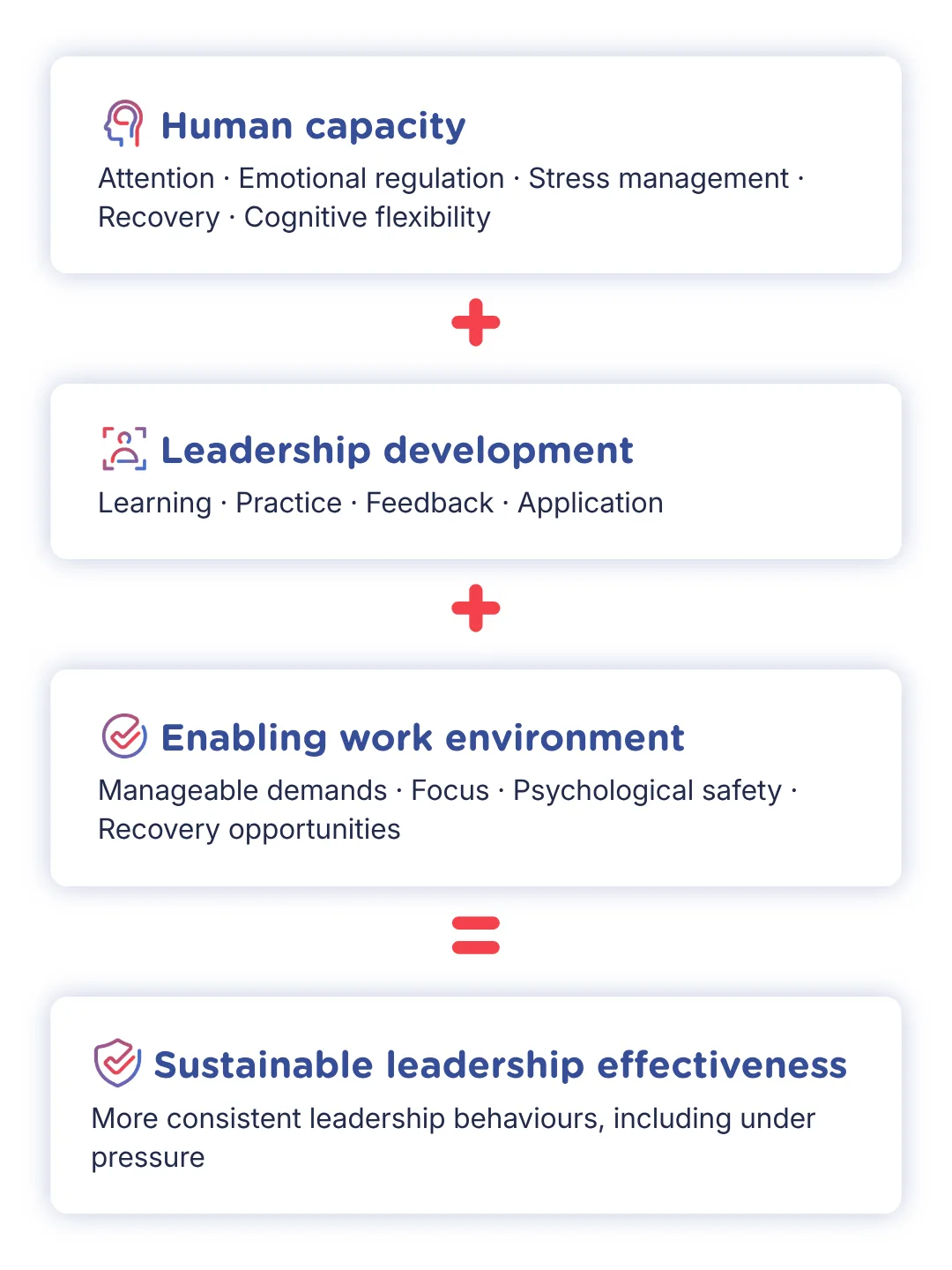
Leadership development doesn’t need replacing. It needs a foundation. Three changes make the difference between programmes that inspire and programmes that change behaviour.
1. Make human capacity part of the core curriculum
Capability without capacity stays theoretical. Asking leaders to perform at a higher level without building their capacity is like asking someone to swim harder when they don’t have enough oxygen.
The good news is that capacity can be developed. Attention, emotional regulation and recovery are skills leaders can learn to manage deliberately, in the same way they learn to delegate or coach.
Foundational human capacity
What it makes possible
What it looks like when it runs out
Attention management
Listening, prioritisation, strategic thinking
Half-listening in meetings, reacting to whatever is loudest
Emotional regulation
Staying composed and responsive in tense moments
Snapping at the team, or avoiding the difficult conversation
Cognitive flexibility
Shifting perspective and leading through uncertainty
Defaulting to familiar answers, resisting change
Recovery and energy management
Sustaining attention and performance over time
Running on empty, decision fatigue, rising burnout risk
These are not optional wellbeing add-ons. They determine how much of the rest of the programme leaders can actually use, so they belong in the core leadership development strategy and its budget.
2. Design for real-world application, and measure behaviour, not satisfaction
Too many programmes are designed to raise awareness or inspire good intentions, and are still judged mainly on satisfaction surveys. A high satisfaction score tells you leaders enjoyed the programme. It doesn’t tell you whether anything changed back at work.
Programmes that change behaviour build practice, feedback, reflection and transfer into daily work from start to finish, not only into the classroom days. They also measure what leaders do differently weeks later. We hold our own work to this standard: 77% of participants in Zest’s one-day Behavioural Resilience workshop reported at least one positive behaviour change 30 days afterwards. Every leadership programme should be able to answer the same question.
3. Create working conditions that support effective leadership
Capability and capacity only go so far if the environment keeps draining them. Leaders operate within a context: workload, meeting culture, performance expectations, and how much psychological safety there is to try new behaviours and sometimes get them wrong. Leaders and their teams need to be able to flag overload early feel safe to and simply say “I’m at capacity” or even “Actually, my brain is fried, I need a break”.
The part of that context most organisations overlook is recovery. Attention, emotional regulation and judgement get used up over a working day and need recovery to rebuild, yet many performance cultures still treat recovery as something you earn once the work is done. For a CHRO, building a culture of recovery means using levers HR already owns: meeting and availability norms that protect focus time, an executive team that visibly role-models switching off, a clear agreement on what stops before a new initiative starts, and performance reviews that reward sustained results rather than last-minute heroics.
Four questions to ask before approving your next leadership programme
Does it build the capacity to use these skills under pressure, or only the skills themselves?
Where will leaders practise in their real work, and who will give them feedback?
How will we know behaviour has changed 30, 60 and 90 days later?
What will we take off leaders’ plates to make room for it?
Leaders are not machines
Building resilient leaders begins when we stop believing they operate like machines. Leaders are human, and human performance has biological limits: attention runs out, stress narrows thinking, and recovery is not optional. Leadership development that ignores this builds skills leaders can only use on their best days.
If organisations want their leadership investment to last, they need to look beyond what leaders are taught and build the capacity, and the conditions, that let leaders use it when it counts.
Cognitive Overload at Work: Why Capable People Can't Keep Up.
Your people's brains are running on empty. Yvon Golbach explains cognitive overload at work, why organisations misdiagnose it, and what actually fixes it.
The Attention Crisis: Why Your People Are Struggling to Think Straight (and What To Do About It)
Constant interruptions and information overload are draining our attention. Discover how cognitive overload impacts decision-making, focus and performance.